

As a supplier of 7.5KW Variable Frequency Drives (VFDs), I am often asked about the energy - saving principles behind these devices. In this blog, I will delve into the key energy - saving principles of a 7.5KW VFD, shedding light on how they can contribute to significant energy savings in various applications.
Variable Speed Control
One of the fundamental energy - saving principles of a 7.5KW VFD is its ability to control the speed of an electric motor. Traditional fixed - speed motors run at a constant speed, regardless of the actual load requirements. This means that even when the load is light, the motor still consumes a significant amount of energy.
A 7.5KW VFD, on the other hand, can adjust the motor speed according to the load demand. The relationship between motor power consumption, speed, and torque is governed by the affinity laws. For a centrifugal pump or a fan, the power consumption is proportional to the cube of the speed. Mathematically, (P_2=P_1\times(\frac{N_2}{N_1})^3), where (P_1) and (P_2) are the power consumptions at speeds (N_1) and (N_2) respectively.
For example, if the speed of a motor is reduced by 20% (from (N_1) to (N_2 = 0.8N_1)), the power consumption will be (P_2=P_1\times(0.8)^3 = 0.512P_1). This means that the motor will consume only about 51.2% of the power it would consume at full speed, resulting in substantial energy savings.
In industrial applications such as water pumping systems and HVAC (Heating, Ventilation, and Air Conditioning) systems, where the load requirements vary throughout the day, a 7.5KW VFD can adjust the motor speed to match the actual demand. This ensures that the motor is not over - working and consuming unnecessary energy, leading to significant cost savings over time.
Soft Start and Stop
Another important energy - saving feature of a 7.5KW VFD is its ability to provide a soft start and stop for the motor. When a traditional motor is started directly, it draws a large inrush current, which can be up to 6 - 8 times the rated current of the motor. This high inrush current not only consumes a large amount of energy but also places a significant stress on the motor and the electrical system.
A 7.5KW VFD gradually ramps up the voltage and frequency to start the motor, reducing the inrush current to a much lower level, typically around 1.5 - 2 times the rated current. This not only saves energy during the starting process but also extends the lifespan of the motor and other electrical components.
Similarly, during the stopping process, a VFD can gradually reduce the speed of the motor, rather than abruptly cutting off the power. This smooth deceleration reduces the mechanical stress on the motor and the connected equipment, and also prevents the generation of excess energy that would otherwise be wasted as heat or mechanical vibrations.
Power Factor Correction
Power factor is an important parameter in electrical systems. It measures the efficiency of the electrical power usage. A low power factor means that a significant portion of the electrical power is being wasted in the form of reactive power.
Most industrial motors have a relatively low power factor, especially when operating at partial loads. A 7.5KW VFD can improve the power factor of the motor by controlling the voltage and current waveforms. By adjusting the phase relationship between the voltage and current, the VFD can reduce the reactive power consumption and increase the overall power factor.
A higher power factor means that more of the electrical power supplied to the motor is being used for useful work, rather than being wasted. This not only saves energy but also reduces the demand on the electrical grid and can result in lower electricity bills, as many utility companies charge for low power factor.
Energy - Efficient Control Algorithms
Modern 7.5KW VFDs are equipped with advanced energy - efficient control algorithms. These algorithms continuously monitor the motor's operating conditions, such as speed, torque, and power consumption, and adjust the VFD's output parameters accordingly.
For example, some VFDs use a technique called flux vector control. This control method allows for precise control of the motor's magnetic flux and torque, ensuring that the motor operates at its most efficient point under all load conditions. By optimizing the magnetic field within the motor, the VFD can reduce the motor's losses and improve its overall efficiency.
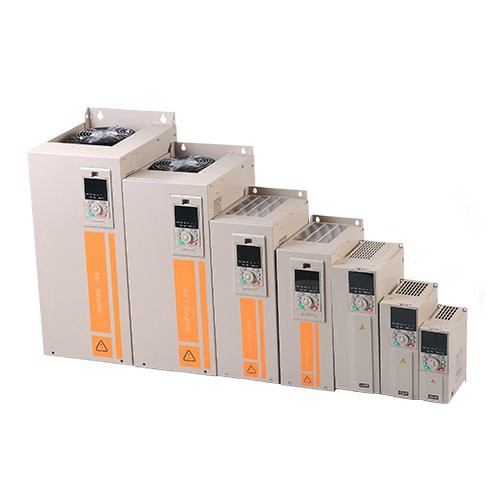
Another common algorithm is the auto - energy optimization feature. This feature automatically adjusts the VFD's output voltage and frequency based on the load demand to minimize energy consumption. When the load is light, the VFD reduces the voltage and frequency to the motor, while still maintaining the required speed and torque. This ensures that the motor is operating at its most energy - efficient level at all times.
Applications and Energy Savings
The energy - saving principles of a 7.5KW VFD make it suitable for a wide range of applications. In the industrial sector, it can be used in conveyor systems, compressors, and mixers. For example, in a conveyor system, the load on the motor varies depending on the amount of material being transported. A 7.5KW VFD can adjust the motor speed to match the load, resulting in significant energy savings.
In the commercial sector, VFDs are commonly used in HVAC systems. Air handling units and chilled water pumps in large buildings often have variable load requirements. By using a 7.5KW VFD to control the motors of these systems, building owners can reduce their energy consumption and operating costs.
In the residential sector, VFDs can be used in applications such as swimming pool pumps. These pumps typically run for long periods, and a 7.5KW VFD can adjust the pump speed based on the pool's usage, saving a considerable amount of energy over time.
Conclusion
In conclusion, the 7.5KW VFD offers several energy - saving principles that can lead to significant cost savings and environmental benefits. Through variable speed control, soft start and stop, power factor correction, and advanced control algorithms, these devices can optimize the energy consumption of electric motors in various applications.

If you are interested in learning more about our AC Control Drive, Frequency Drive for Single Phase Motor, or Frequency Drive Controller, or if you are looking to purchase a 7.5KW VFD for your specific application, please do not hesitate to contact us. We are committed to providing high - quality VFDs and excellent customer service. Our team of experts can help you select the right VFD for your needs and provide you with detailed information on installation, operation, and maintenance.
References
- Chapman, S. J. (2012). Electric Machinery Fundamentals. McGraw - Hill.
- Bose, B. K. (2002). Power Electronics and AC Drives. Prentice Hall.
- Mohan, N., Undeland, T. M., & Robbins, W. P. (2012). Power Electronics: Converters, Applications, and Design. Wiley.