

Hey there! As a supplier of 18.5KW Variable Frequency Drives (VFDs), I often get asked about the output voltage of these nifty devices. So, I thought I'd write this blog to clear up any confusion and give you all the deets.
First off, let's understand what a VFD does. A VFD is a type of motor controller that drives an electric motor by varying the frequency and voltage supplied to the motor. It's like a magic box that can adjust the speed of your motor according to your needs, which is super useful in a whole bunch of industrial applications. Whether you're running a conveyor belt, a pump, or a fan, a VFD can help you save energy and improve the performance of your equipment.
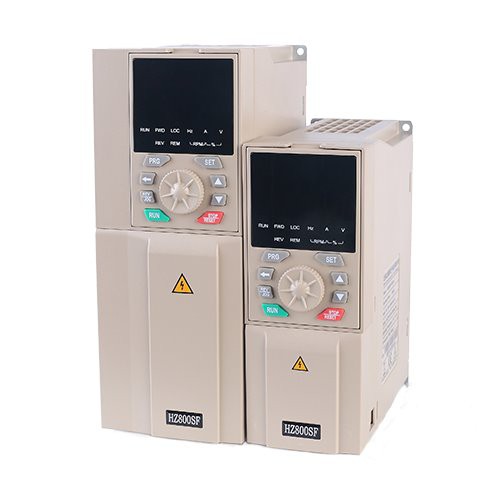

Now, back to the main question: what's the output voltage of a 18.5KW VFD? Well, it's not a one - size - fits - all answer. The output voltage of a VFD depends on several factors, the most important being the input voltage and the design of the drive itself.
Most commonly, in industrial settings, the input voltage for a 18.5KW VFD can be either 208V, 230V, or 480V, with three - phase power being the norm. The VFD is designed to take this input voltage and convert it into an adjustable output voltage and frequency to control the motor.
If the input voltage is 208V three - phase, the output voltage of the VFD can typically range from 0V to 208V. This allows for a wide range of speed control for the motor connected to it. Similarly, for a 230V three - phase input, the output voltage can go from 0V up to 230V. And if you're using a 480V three - phase input, the output voltage will be adjustable from 0V to 480V.
It's important to note that the output voltage of a VFD is not fixed. It changes in proportion to the frequency output. This relationship is based on the principle of volts - per - hertz (V/Hz) control. For example, in a standard motor, the rated voltage and frequency are designed to maintain a certain magnetic flux in the motor's core. The VFD keeps this ratio constant to ensure the motor operates efficiently. So, as the frequency is decreased, the output voltage is also decreased proportionally, and vice versa.
Let's say you have a motor that's rated for 460V at 60Hz. The V/Hz ratio for this motor is 460V / 60Hz = 7.67 V/Hz. When you use a VFD to control this motor, if you want to run the motor at 30Hz, the VFD will output a voltage of approximately 30Hz * 7.67 V/Hz = 230V. This way, the motor can operate smoothly at different speeds without overheating or losing efficiency.
Another factor that can affect the output voltage is the load on the motor. When the motor is under a heavy load, the VFD may need to increase the output voltage slightly to maintain the desired speed. On the other hand, if the load is light, the output voltage can be reduced.
Now, you might be wondering about single - phase VFDs. While most 18.5KW VFDs are designed for three - phase applications, there are single - phase options available too. You can check out Single Phase VFD Drive for more information on these. Single - phase VFDs usually have different input and output voltage characteristics compared to three - phase ones. They typically have lower power ratings and are used in smaller applications where three - phase power is not available.
The output voltage of a single - phase VFD can also vary depending on the input voltage. Common single - phase input voltages are 110V or 230V. The output voltage will be adjusted according to the same V/Hz principle as three - phase VFDs, but the range will be different.
In addition to the basic output voltage adjustment, modern 18.5KW VFDs come with a whole bunch of advanced features. For example, some VFDs can provide a "boost" voltage at low frequencies. This is useful because at low speeds, the motor may need a little extra voltage to overcome the static friction and start smoothly.
Also, many VFDs have built - in protection mechanisms that can limit the output voltage in case of a fault. For instance, if there's a short - circuit in the motor or the wiring, the VFD will quickly reduce the output voltage to prevent damage to the equipment.
When it comes to choosing the right 18.5KW VFD for your application, it's crucial to consider the output voltage requirements. You need to make sure that the VFD can provide the appropriate voltage range for your motor. If you're not sure, you can always consult with an expert or check out VFD For Motors for more guidance.
Moreover, if you're interested in the control aspect of VFDs, VFD Control Drive is a great resource. It offers detailed information on how to operate and configure VFDs to get the best performance out of your motors.
As a supplier of 18.5KW VFDs, I've seen firsthand how these devices can transform the way you run your industrial operations. They not only save energy but also extend the lifespan of your motors by reducing wear and tear.
If you're in the market for a 18.5KW VFD, I'd love to have a chat with you. Whether you have questions about the output voltage, the installation process, or just need some general advice, I'm here to help. Reach out to me, and we can start a conversation about how a 18.5KW VFD can meet your specific needs.
In conclusion, the output voltage of a 18.5KW VFD is a variable parameter that depends on the input voltage, the frequency output, and the load on the motor. Understanding these factors is essential for choosing the right VFD and ensuring the efficient operation of your motor. So, don't hesitate to get in touch if you're looking to make a purchase. Let's work together to find the perfect VFD solution for your business.
References
- Electric Motor Handbook
- Variable Frequency Drive Installation and Troubleshooting Guide