


Why Choose Us
Professional team: Our team of experts has many years of experience in the industry, and we provide our customers with the necessary support and advice.
High-quality products: Our products are manufactured to the highest standards using only the best materials. We ensure that our products are reliable, safe and long-lasting.
24H online service: The 400 hotline is open 24 hours a day. Fax, email, QQ, and telephone are all-round and multi-channel to accept customer problems. Technical personnel are 24 hours a day to answer customer problems.
One-stop solution: Provide technical support in the whole process of inspection, installation, commissioning, acceptance, performance acceptance test, operation, maintenance and other corresponding technical guidance and technical training related to contract products in a timely manner.
MPPT or maximum power point tracking is algorithm that included in charge controllers used for extracting maximum available power from PV module under certain conditions. The voltage at which PV module can produce maximum power is called maximum power point (or peak power voltage). Maximum power varies with solar radiation, ambient temperature and solar cell temperature.




Why Choose MPPT?
Increased energy harvest
MPPT controllers operate array voltages above battery voltage and increase the energy harvest from solar arrays by 5 to 30% compared to PWM controllers, depending on climate conditions.
Array operating voltage and amperage is adjusted throughout the day by the MPPT controller so that the array's power output (amperage x voltage) is maximized.
Less module restrictions
Since MPPT controllers operate arrays at voltages greater than battery voltage, they can be used with a wider variety of solar modules and array configurations. Moreover, they can support systems with smaller wire sizes.
Support for oversized arrays
MPPT controllers can support oversized arrays that would otherwise exceed the maximum operating power limits of the charge controller. The controller does this by limiting the array current intake during periods of the day when high solar energy is being supplied (usually during the middle of the day).
How Maximum Power Point Tracking Works?
Here is where the optimization or maximum power point tracking comes in. Assume your battery is low, at 12 volts. An MPPT takes that 17.6 volts at 7.4 amps and converts it down so that what the battery gets is now 10.8 amps at 12 volts. Now you still have almost 130 watts, and everyone is happy.
Ideally, for 100% power conversion you would get around 11.3 amps at 11.5 volts, but you have to feed the battery a higher voltage to force the amps in. And this is a simplified explanation - in actual fact, the output of the MPPT charge controller might vary continually to adjust for getting the maximum amps into the battery.
If you look at the green line, you will see that it has a sharp peak at the upper right - that represents the maximum power point. What an MPPT controller does is "look" for that exact point, then does the voltage/current conversion to change it to exactly what the battery needs. In real life, that peak moves around continuously with changes in light conditions and weather.
Under very cold conditions a 120-watt panel is actually capable of putting over 130+ watts because the power output goes up as panel temperature goes down - but if you don't have some way of tracking that power point, you are going to lose it. On the other hand under very hot conditions, the power drops - you lose power as the temperature goes up. That is why you get less gain in summer.
Why I Need a MPPT?
MPPT's are most effective under these conditions: Winter, and/or cloudy or hazy days - when the extra power is needed the most.


Cold weather
Solar panels work better at cold temperatures, but without an MPPT you are losing most of that. Cold weather is most likely in winter - the time when sun hours are low and you need the power to recharge batteries the most.
Low battery charge
The lower the state of charge in your battery, the more current an MPPT puts into them - another time when the extra power is needed the most. You can have both of these conditions at the same time.
Long wire runs
If you are charging a 12-volt battery, and your panels are 100 feet away, the voltage drop and power loss can be considerable unless you use very large wire. That can be very expensive. But if you have four 12 volt panels wired in series for 48 volts, the power loss is much less, and the controller will convert that high voltage to 12 volts at the battery. That also means that if you have a high voltage panel setup feeding the controller, you can use much smaller wire.
● In any applications which PV module is energy source, MPPT solar charge controller is used to correct for detecting the variations in the current-voltage characteristics of solar cell and shown by i-v curve.
● MPPT solar charge controller is necessary for any solar power systems need to extract maximum power from PV module, it forces PV module to operate at voltage close to maximum power point to draw maximum available power.
● MPPT solar charge controller allows users to use PV module with a higher voltage output than operating voltage of battery system.
With a MPPT solar charge controller, users can wire PV module for 24 or 48 V (depending on charge controller and PV modules) and bring power into 12 or 24 V battery system. This means it reduces the wire size needed while retaining full output of PV module.
● MPPT solar charge controller reduces complexity of system while output of system is high efficiency. Additionally, it can be applied to use with more energy sources. Since PV output power is used to control DC-DC converter directly.
● MPPT solar charge controller can be applied to other renewable energy sources such as small water turbines, wind-power turbines, etc.
Algorithms for MPPT
Algorithms for MPPT are various types of schemes that are implemented for obtaining maximum power transfer. Some of the popular schemes are incremental conductance method, system oscillation method, hill climbing method, modified hill climbing method, constant voltage method. Other MPPT methods include those which use state space approach with the tracking power converter operating in continuous conduction mode (CCM) and the another one which is based on a combination of incremental conductance and perturb and observe method. Energy extracted from the PV source through MPPT should be either utilized by a load or stored in some form for example, energy stored in a battery or used for electrolysis to produce hydrogen for future use in fuel cells. In view of this grid connected PV systems are very popular as they do not have any energy storage requirements since the grid can absorb any amount of PV energy tracked.
Some of the popular and most commonly used MPPT schemes are explained below:

The ration of VMPP and Voc is a constant approxiately equal to 0.78. Here array voltage is represented by VMPP and the open circuit voltage is represented by Voc.The sensed PV array voltage is compared with a reference voltage to generate an error signal which in turn controls the duty cycle. The duty cycle of the power converter ensures that the PV array voltage is equal to 0.78 × Voc. Also Voc can be determined using a diode mounted at the back of the array (so that it has the same temperature as the array). A constant current is fed into the diode and the resulting voltage across the diode is used as the arrays VOC which then utilized in tracking VMPP.
Hill climbing method
The most popular algorithm is the hill climbing method. It is applied by perturbing the duty cycle 'd' at regular intervals and by recording the resulting array current and voltage values, thereby obtaining the power. Once the power is known, a check for the slope of the P- V curve or the operating region (current source or voltage source region) is carried out and then the change in d is effected in a direction so that the operating point approaches maximum power point on the power voltage characteristic.The algorithm of this scheme is described below along with the help of mathematical expressions:
In a voltage source region, ∂PPV / ∂VPV > 0 = d = d + δd (i.e., increment d)
In the current source region, ∂PPV / ∂VPV < 0 = d = d - δd (i.e., decrement d)
At maximum power point, ∂PPV / ∂VPV = 0 = d = d or δd = 0 (i.e., retain d)
This means that the slope is positive and the module is operating in the constant current region. In case of the slope being negative (Pnew < Pold) the duty cycle is reduced (d = d - δd), as the operating region in this case is the constsnt voltage region. This algorithm can be implemented using a microcontroller.

Incremental Conductance Method
In the incremental conductance method, the maximum power point by matching the PV array impedance wit the effective impedance of the converter reflected across the terminals of the array. While, latter is tuned by increase or decrease in the duty cycle value. The algorithm can be explained as follows:
For voltage source region, ∂IPV / ∂VPV > - IPV / VPV = d = d + δd (i.e., increment duty cycle)
For current source region, ∂IPV / ∂VPV < - IPV / VPV = d = d - δd (i.e., decrement duty cycle)
At maximum power point, ∂IPV / ∂VPV = d = d or δd = 0
Incremental Conductance Mppt Method
Off-grid PV system are usually using batteries to supply loads at night. Although the fully charged battery pack voltage may be near to the maximum power point voltage of the PV panel's, this is not true at sunrise when the partial discharge of the battery takes place. At a certain voltage below the maximum voltage of the PV panel, charging takes place and this mismatch can be resolved using an MPPT. In case of a grid connected PV system, all the delivered power from solar modules will be sent to the grid. Therefore, the MPPT in a grid connected photovoltaic system will always try to operate the PV modules at its maximum power point.

Applications of MPPT Solar Charge Controllers
The following basic solar panel installation system shows the important rule of solar charge controller and an inverter. The inverter (which converts dc power from both batteries and solar panels into ac power) is used to connect the ac appliances through charge controller. On the other hand, the dc appliances can be directly connected to the solar charge controller to feed up the dc power to the appliances via PV panels and storage batteries.
A solar street light system is a system that uses a PV module to transform sunlight to dc electricity. The device uses only dc energy and includes a solar charge controller to store dc in the battery compartment to not be visible during daylight or night.
The solar home system uses energy generated from the PV module to supply home appliances or other household appliances. The device includes a solar charge controller to store dc in the battery bank and a suit for use in any environment where the power grid is not available.
The hybrid system consists of various sources of energy to provide full-time emergency power or other purposes. It typically integrates a solar array with other means of generation such as diesel generators and renewable energy sources (wind turbine generator and hydro generator, etc.). It includes a solar charge controller to store dc in a battery bank.
The solar water pumping system is a system that uses solar power to pump water from natural and surface reservoirs for the house, village, water treatment, agriculture, irrigation, livestock, and other applications.
MPPT solar charge controller minimizes the complexity of any system keeping the output of the system high. Additionally, you can use it with more various other energy sources.
MPPT systems use algorithms to track changes in these parameters over time and make automatic adjustments, so whether it's a cloudy or sunny day and regardless of load requirements, your system will always work at peak levels. This is a game-changer, as it means even if there's not loads of sunlight at any given moment, your solar panels keep producing power throughout the day.
Another way to look at it is to imagine you have a smart device functioning as a personal power optimizer, consistently working to get the most out of your solar panels. That's MPPT's primary function – it measures the open-circuit voltage (VOC) and short-circuit current (LSC) to figure out the best operating point on the maximum power (PMAX). This is the kind of tech that lets you relax, knowing you're getting ultimate efficiency from your solar power system.
How To Connect MPPT?
Step 1: Find the wiring terminals
The MPPT models are different. Some provide a terminal on the outside and some have a terminal inside the cover. So, if you couldn't find them outside, open the cover you will find six ports. Two for the batteries, two for the solar arrays, and two for the dc load. Additionally, your MPPT model may have ports for the temperature sensor and the PC connection.
Step 2: Connect battery
The battery has two terminals, one for positive and one for negative. Use proper charging wires to connect the battery terminals with the ports of the MPPT. Connect positive with positive and negative with the negative terminal.
Step 3: Connect solar panels
The solar panels will have a positive and negative connection. Connect the positive with the positive and negative with the negative of the MPPT's solar port. Be double sure about the signs or else you may harm your charge controller.
Step 4: Connect DC load (optional)
Most MPPT charge controllers come with a dc load terminal. If you have a separate dc load like a mobile charger, you can directly connect it. However, it isn't part of the connection between solar array and batteries. Its absence won't affect the procedure.
Step 5: Connect temperature sensor and PC (optional)
Usually, the MPPT charge controller has a temperature sensor and PC port for extra control and safety. If your charge controller does not come with their wires, buy extra and enhance your control over solar arrays.
Under What Conditions Is MPPT Most Effective?
Winter, and/or cloudy or hazy days - when the extra power is needed the most.
Cold weather: Solar panels work better at cold temperatures, but without an MPPT you are losing most of that. Cold weather is most likely in winter - the time when sun hours are low and you need the power to recharge batteries the most.
Low battery charge: The lower the state of charge in your battery, the more current an MPPT puts into them - another time when the extra power is needed the most. You can have both of these conditions at the same time.
Long wire runs: If you are charging a 12-volt battery, and your panels are 100 feet away, the voltage drop and power loss can be considerable unless you use very large wire. That can be very expensive. But if you have four 12 volt panels wired in series for 48 volts, the power loss is much less, and the controller will convert that high voltage to 12 volts at the battery. That also means that if you have a high voltage panel setup feeding the controller, you can use much smaller wire.
Our Factory
Zhejiang Hertz Electric Co., Ltd., founded in 2014, is high-tech enterprise specializing in the development, manufacture, sales, and after-sales service, serving medium and high-end equipment manufacturers and industrial automation system integrators. Relying on high-quality production equipment and rigorous testing process, we will provide customers with products such as low-voltage and medium voltage inverters, soft starters and servo control systems and solutions in related industries.
The company upholds to the concept of "providing users with the best products and services" to serve every costomer. At present, it is mainly used for metallurgy, chemical industry, paper making, machinery and other industries.


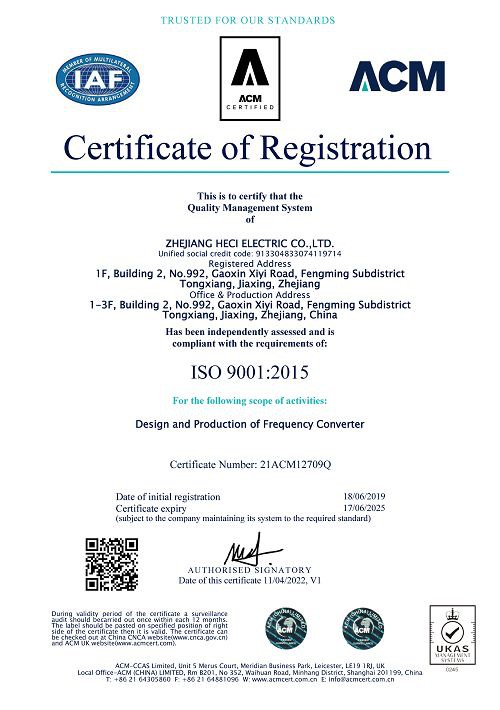
Certifications


FAQ
Q: What does an MPPT do?
Q: Do I need MPPT or inverter?
Q: What is better MPPT or PWM?
Q: What is the advantage of an MPPT controller?
Q: Do inverters have built in MPPT?
Q: Do I need an MPPT for each solar panel?
Q: Do all inverters have MPPT?
Q: Is MPPT worth the extra cost?
Q: Should I connect my solar panels in series or parallel?
Q: What is the lifespan of MPPT?
Q: Does MPPT prevent overcharging?
Q: Can I use MPPT without inverter?
Q: How many volts can a MPPT charge controller handle?
Q: What happens if a MPPT is used without a battery?
Q: Does MPPT work better with high voltage?
Q: Why is MPPT used in solar panels?
Q: How do I match my solar panels to MPPT?
Q: What are the types of MPPT?
Q: What are the conventional MPPT techniques?
Q: How do I check my MPPT?
Hot Tags: mppt, China mppt manufacturers, suppliers, factory, solar powered apartment complex pump, Empty Water Level Delay, High Level Float Alarm, MPPT, Full Water Level Delay, Solar Powered Pump Drives