


Industrial Motor Speed Control & Energy Efficiency Optimization
In modern industrial manufacturing, electric motors represent one of the largest contributors to factory electricity consumption. Many motors still operate at fixed speed regardless of actual process demand, while traditional control methods such as mechanical valves and dampers regulate output by wasting excess energy.
These operating methods can result in unnecessary power consumption, higher starting current, increased mechanical stress, and additional maintenance requirements.
Our Energy-Saving General Purpose VFD is an industrial frequency inverter designed to improve motor efficiency and process control by dynamically matching motor output with actual load requirements.
By combining intelligent energy optimization algorithms, sensorless vector control (SVC), and flexible automation functions, the drive helps reduce operational costs, improve equipment reliability, and provide a practical solution for pumps, fans, compressors, conveyors, and industrial automation systems.
Core Technical Specifications
Designed for reliable operation in industrial environments, the Energy-Saving General Purpose VFD provides flexible configuration options for different motor applications.
|
Parameter |
Specification |
|
Power Range |
0.75 kW to 500 kW |
|
Input Voltage |
Three-phase 380V–460V (±15% voltage tolerance) |
|
Output Frequency Range |
0.00 Hz – 600.00 Hz |
|
Control Mode |
Sensorless Vector Control (SVC), V/F Control |
|
Overload Capacity |
150% rated current for 60 seconds (Heavy-duty rating) |
|
Speed Control Accuracy |
±0.5% (Sensorless Vector Control) |
|
Communication |
RS485 Modbus RTU |
|
Cooling System |
Intelligent forced-air cooling |
|
Protection Functions |
Overcurrent, overvoltage, overload, phase loss, overheating protection |
|
Compliance |
Designed according to CE and RoHS requirements; manufactured under ISO 9001 quality management system |
Engineering & Commissioning Guide
The drive is designed with an engineer-friendly parameter structure to simplify installation, commissioning, and system integration.
Commissioning Process
Wiring & Verification
Confirm power supply, motor wiring, grounding, and control connections according to the electrical diagram.
Motor Nameplate Data Input
Enter motor parameters including:
Rated power
Rated voltage
Rated current
Rated frequency
Rated speed
Static/Dynamic Auto-Tuning
Perform motor parameter identification to improve sensorless vector control performance.
PID / Communication Configuration
Configure:
PID control parameters
Frequency reference source
Communication address
Control mode
Load Trial Operation
Test motor operation under actual working conditions and monitor current, speed stability, and system response.
Fine Adjustment & Handover
Optimize parameters according to application requirements.
Critical Installation Recommendations
EMC Considerations
For applications with long motor cable distances or sensitive control equipment, additional EMC measures such as output reactors, filters, or proper cable separation may be required.
Thermal Management
Install the VFD inside a properly ventilated electrical enclosure and maintain sufficient clearance around the unit to ensure effective heat dissipation.
Wiring Practice
Power cables and control cables should be routed separately to reduce electromagnetic interference and improve signal stability.
Technical Differentiation: Standard VFD vs. Energy-Saving VFD
While conventional VFDs mainly focus on motor speed adjustment, our Energy-Saving VFD series integrates load monitoring and energy optimization functions to improve operating efficiency, especially under partial-load conditions.
|
Feature / Specification |
Standard General-Purpose VFD |
Our Energy-Saving VFD Series |
B2B Operational Advantage |
|
Energy Optimization Algorithm |
Fixed V/F control |
Dynamic Energy Optimization (DEO) |
Helps reduce unnecessary energy consumption in variable-load applications |
|
Control Architecture |
Basic V/F control |
Sensorless Vector Control (SVC) & V/F |
Provides stable torque output and improved low-speed performance |
|
Starting Performance |
Standard starting torque |
Up to 150% torque at 0.5Hz (SVC mode) |
Suitable for applications requiring stronger starting capability |
|
Communication Protocols |
Optional configuration |
Standard RS485 Modbus RTU |
Simplifies integration with PLC, HMI, and SCADA systems |
|
Built-in Process Control |
External controller usually required |
Integrated dual-channel PID loop |
Reduces additional control hardware requirements |
|
Environmental Protection |
Standard PCB protection |
Heavy-duty conformal coating option |
Improves resistance against moisture, dust, and industrial environments |
Industrial Application Examples
Municipal Wastewater Treatment – Variable Torque Pump Application
• Application: Centrifugal wastewater pump system requiring stable flow control.
• Challenge: The original system used mechanical valve regulation while the motor operated at constant speed, resulting in unnecessary energy consumption and unstable pressure control.
• Solution: The VFD was integrated with PID feedback control using pressure or flow sensors to automatically adjust pump speed according to system demand.
• Improvement: Reduced unnecessary pump operation
• Improved pressure stability:
Reduced mechanical stress caused by frequent valve adjustment
Improved overall system efficiency
Actual energy savings depend on operating conditions, load profile, and system design.
Textile Production Line – Constant Torque Application
• Application: Textile machinery requiring stable speed control and smooth starting.
• Challenge: Direct motor starting caused high mechanical impact and increased maintenance requirements.
• Solution: Sensorless vector control with controlled acceleration and deceleration was applied to achieve smoother operation.
• Improvement:
Reduced mechanical shock
Improved speed stability
Reduced maintenance frequency
Improved production consistency
Comprehensive System Protection
|
Fault Condition |
Protection Function |
Equipment Protected |
|
Overcurrent / Short Circuit |
Fast fault detection and output protection |
Inverter module and motor winding |
|
Overvoltage |
DC bus monitoring and braking management |
Drive electronics and DC capacitors |
|
Input/Output Phase Loss |
Phase monitoring and protective shutdown |
Motor stator and power system |
|
Thermal Overload |
Temperature monitoring and overload protection |
Drive and connected motor |
|
Motor Stall |
Automatic current and torque limitation |
Motor and mechanical system |
|
Communication Fault |
Communication monitoring and fault alarm |
Automation system reliability |
OEM & ODM Services
We support global machine builders, system integrators, and industrial distributors with flexible customization options.
Custom Firmware & Parameter Configuration
Pre-configured parameters can be developed for specific applications, including:
Pump control profiles
Compressor applications
Conveyor systems
Textile machinery functions
Private Label Manufacturing (OEM)
Available services include:
Custom branding
Product labeling
Customized manuals
Packaging solutions
Technical Support
Our engineering team provides assistance with:
Product selection
Application analysis
Parameter configuration
Installation guidance
Commissioning support
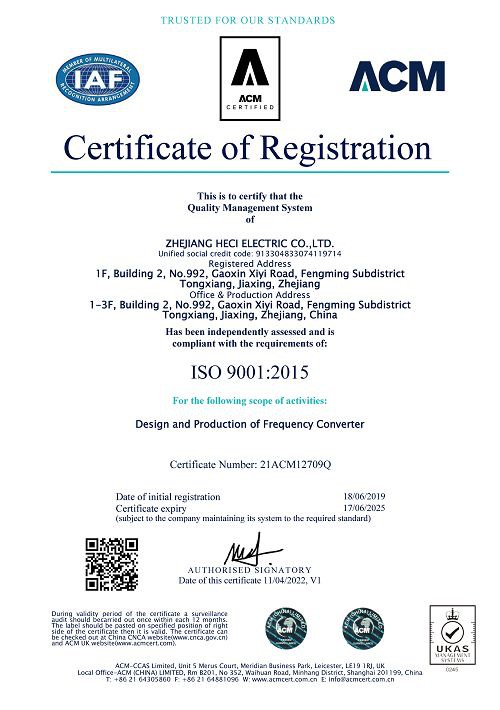
Certificate



FAQ
Q: Does the VFD include built-in harmonic mitigation or EMC filters?
A: Selected models include built-in DC reactors to improve input power performance. EMC filters can be configured according to application requirements to help meet industrial electromagnetic compatibility requirements.
Q: Can this VFD control permanent magnet synchronous motors (PMSM)?
A: The standard version is optimized for three-phase asynchronous induction motors. PMSM control versions are available depending on project requirements.
Q: What is the standard lead time for bulk OEM orders?
A: Lead time depends on model selection, order quantity, and customization requirements. Standard configurations usually have shorter delivery cycles, while OEM/ODM projects require additional production time.
Q: How do I select the correct VFD model for my motor?
A: Selection should consider motor power, voltage, current, load type, overload requirement, operating environment, and communication requirements.
Q: Can this VFD be used for pumps and fans?
A: Yes. Pumps and fans are common applications because variable-speed control can match motor output with changing flow or pressure requirements.
Q: Does the VFD support PLC and HMI communication?
A: Yes. Standard RS485 Modbus RTU communication allows integration with PLCs, HMIs, and industrial automation systems.
Q: Is PID control built into the VFD?
A: Yes. The integrated PID function can be used for applications requiring automatic pressure, flow, or temperature regulation.
Q: Can the VFD replace a traditional motor starter?
A: In many applications, the VFD can replace direct-on-line starters by providing controlled acceleration, reduced starting current, and adjustable speed operation.
Q: What protection functions are included?
A: Standard protection includes overcurrent, overvoltage, undervoltage, overload, overheating, phase loss, stall prevention, and communication fault protection.
Q: Can you provide OEM customization?
A: Yes. OEM services include branding, parameter customization, firmware configuration, packaging, and technical documentation customization.
Q: What documents are available before purchase?
A: We provide datasheets, user manuals, wiring diagrams, communication manuals, dimension drawings, and technical support documents.
Q: What information should customers provide before requesting a quotation?
A: Recommended information includes motor power, voltage, application type, load characteristics, quantity requirement, and required communication protocol.
Hot Tags: energy saving general purpose vfd, China energy saving general purpose vfd manufacturers, suppliers, factory, Three Phase VFD, VFD, vfd in cnc machines, vfd in inverters, vfd in programmable logic controllers, vfd in turning machines