

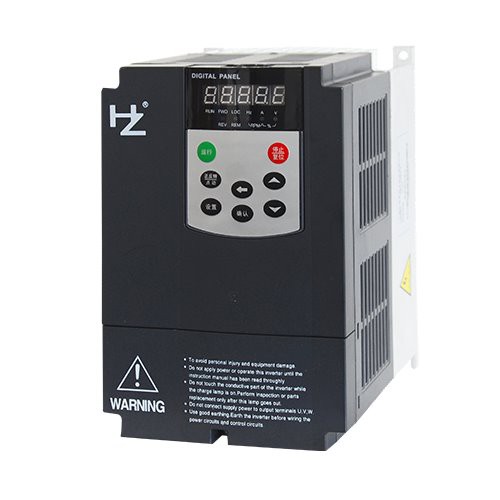
Reliable Motor Control Solution for Industrial Machinery, OEM Equipment and Automation Systems
In industrial automation applications, motor control performance directly affects machine productivity, product quality, and operating cost.
Traditional V/F control drives are suitable for basic speed regulation, but they may experience limitations when machines require higher starting torque, faster response to load changes, or stable operation at low speed.
Our General Purpose Vector Control VFD is engineered to provide improved motor control performance through advanced sensorless vector control technology. By accurately managing motor flux and torque components, the drive delivers more stable torque output, improved speed regulation, and smoother operation across different industrial conditions.
Designed for distributors, OEM manufacturers, and automation system integrators, this series provides a practical balance between performance, reliability, and cost efficiency, helping customers simplify equipment design and reduce long-term maintenance requirements.
Technical Specification
|
Item |
Specification |
|
Control Mode |
V/F Control, Sensorless Vector Control |
|
Output Frequency |
0–500Hz (Model dependent) |
|
Overload Capability |
Up to 150% rated current for short-time operation |
|
Motor Type |
Three-phase induction motor |
|
Communication |
RS485 / Modbus RTU |
|
Protection Functions |
Over voltage, over current, overload, over temperature |
|
Application Type |
General industrial machinery |
|
Installation |
Wall-mounted / Control cabinet installation |
(Detailed specifications vary according to product series and power range.)
Why Choose Our General Purpose Vector Control VFD?
For industrial distributors and OEM customers, the right VFD is not only about frequency conversion. It is about providing a reliable motor control solution that performs consistently in real-world applications.
Our General Purpose Vector Control VFD combines:
Practical vector control performance
Wide industrial application compatibility
Reliable protection design
Easy commissioning features
Flexible OEM support
It helps partners deliver stable machine performance while reducing installation complexity and long-term service costs.
Engineering Problems We Designed To Solve
Industrial VFD selection is not only about output power. Incorrect drive selection or unsuitable control technology can lead to:
Insufficient Starting Torque
• Common Cause: Basic V/F drives may not provide enough torque at low frequency, especially during heavy starting conditions.
• Our Solution: Vector control technology improves torque current regulation, allowing motors to deliver stronger starting capability and smoother acceleration.
Speed Fluctuation During Load Changes
• Common Cause: When mechanical loads change suddenly, motor slip increases and speed stability decreases.
• Our Solution: The VFD continuously adjusts motor control parameters to compensate for load variations and maintain more stable operation.
Long Commissioning Time
• Common Cause: Incorrect motor parameters and complicated adjustment procedures increase installation time.
• Our Solution: Automatic motor tuning and flexible parameter configuration simplify commissioning for OEM engineers and installers.
Typical Application Solutions
Conveyor Systems
• Customer Challenge: Frequent load changes can cause speed fluctuation and motor overload.
• VFD Solution: Vector control maintains more stable torque output during changing loads, improving material transportation consistency.
Pumps and Fans
• Customer Challenge: Fixed-speed motors often waste energy when system demand changes.
• VFD Solution: Variable speed regulation allows motors to operate closer to actual process requirements, reducing unnecessary energy consumption.
Extruders and Mixers
• Customer Challenge: High starting torque and unstable loads can affect product quality.
• VFD Solution: Improved torque response provides smoother operation during acceleration and production changes.
Vector Control VFD vs Traditional V/F Drive
|
Feature |
V/F Drive |
Vector Control VFD |
|
Low-Speed Torque |
Limited |
Improved torque output |
|
Load Response |
Slow |
Faster dynamic response |
|
Speed Stability |
Moderate |
Higher accuracy |
|
Heavy Starting Load |
Less suitable |
Better performance |
|
Application Range |
Basic applications |
Industrial machinery |
Manufacturing Quality & Reliability Control
Reliable VFD performance depends not only on software algorithms but also on manufacturing consistency.
Our production process includes:
Component Quality Control
Incoming inspection of critical electronic components
Supplier quality verification
Production traceability management
Functional Testing
Each drive is tested for:
Input/output performance
Protection functions
Communication functions
Control response
Reliability Verification
Before shipment, units undergo:
Aging tests
Load simulation testing
Parameter verification
This process helps ensure stable performance across different production batches and supports long-term cooperation with global distributors and OEM customers.
Certificate


Partnering with Us: Supply Chain & Global Support
For industrial distributors and OEM partners, product reliability is only half the equation. We provide the commercial infrastructure to safeguard your operations:
Warranty & Longevity: All units are backed by a 12 to 24-month comprehensive warranty, with guaranteed spare parts availability for 10 years to support long machine lifecycles.
Flexible OEM/ODM & Localization: We support custom firmware parameter presetting (reducing your factory flashing time), customized branding/labeling, and localized multilingual technical documentation.
Global Compliance: Fully certified to international industrial standards, simplifying your equipment export process to European and North American markets.
FAQ
Q: What is the difference between a vector control VFD and a standard V/F VFD?
A: A vector control VFD provides more accurate control of motor torque and speed by separating motor flux and torque components. This allows better performance during low-speed operation and changing loads compared with traditional V/F control.
Q: What applications require vector control instead of V/F control?
A: Applications with frequent load changes, heavy starting torque requirements, or strict speed stability requirements usually benefit from vector control technology.
Examples include conveyors, mixers, extruders, and industrial machinery.
Q: Can this VFD be used for OEM machine production?
A: Yes. The product supports flexible parameter configuration and industrial communication options, making it suitable for OEM equipment manufacturers and system integrators.
Q: What advantages does this VFD provide to distributors?
A: The main advantages include wider application coverage, easier customer matching, reduced inventory complexity, and lower technical support requirements.
Q: Is this VFD suitable for OEM machine manufacturers?
A: Yes.
The drive supports flexible parameter configuration, communication integration, and customization options, making it suitable for OEM equipment development and machine production.
Q: What motors are compatible with this vector control VFD?
A: Depending on model configuration, the drive can support common industrial motors including:
Three-phase induction motors
High-efficiency IE2/IE3 motors
Permanent magnet motors (selected models)
Q: What support can distributors receive from the manufacturer?
A: Distributors can receive:
Product selection assistance
Technical documentation
Application support
OEM customization
After-sales troubleshooting support
Q: What is the typical service life of an industrial VFD?
A: Actual service life depends on installation environment, operating temperature, load conditions, and maintenance.
With proper installation and operation, industrial VFDs are typically designed for many years of continuous service in factory automation environments.
Q: Does the VFD support PLC integration?
A: Yes.
Models with industrial communication options such as RS485 Modbus-RTU can be integrated into PLC-based automation systems for centralized control.
Q: What should I consider when selecting a General Purpose Vector Control VFD?
A: Important selection factors include:
Motor power and rated current
Load characteristics
Starting torque requirement
Operating environment
Communication requirements
Overload capability
Hot Tags: general purpose vector control vfd, China general purpose vector control vfd manufacturers, suppliers, factory, 660V 690V VFD, VFD Compatible Motor, vfd in copiers, vfd in fax machines, vfd in painting robots, vfd in programmable logic controllers