

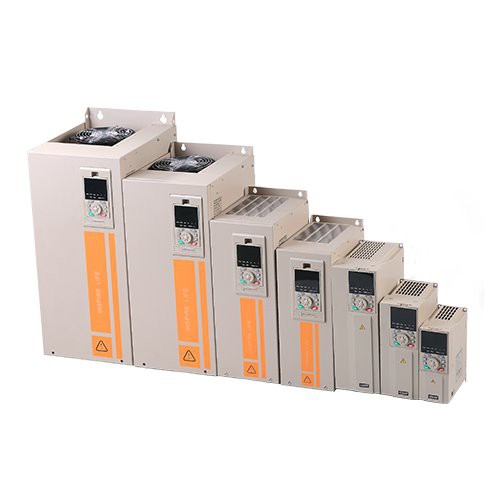
Precision Motor Control with Real-Time Encoder Feedback for Heavy-Duty Industrial Equipment
For industrial OEMs and machine builders, motor control performance directly influences equipment reliability, production efficiency, and customer satisfaction.
When machines operate under changing loads, frequent acceleration cycles, or demanding low-speed conditions, conventional VFDs may experience speed deviation, unstable torque output, or delayed response.
Our Closed Loop Vector Control VFD is designed for applications requiring accurate speed regulation, reliable torque control, and stable operation under dynamic load conditions.
By combining encoder feedback technology with advanced vector control algorithms, the drive continuously monitors motor speed and position, allowing real-time correction of output performance.
Typical Technical Specifications
|
Item |
Specification |
|
Control Mode |
Closed Loop Vector Control / Sensorless Vector / V/F |
|
Motor Type |
AC Induction Motor, PMSM |
|
Encoder Feedback |
Incremental / Optional Absolute Encoder |
|
Speed Accuracy |
Up to ±0.01% under suitable conditions |
|
Speed Control Range |
Up to 1:1000 |
|
Starting Torque |
High torque performance at zero and low speed |
|
Overload Capacity |
Heavy Duty models available |
|
Communication |
Modbus RTU, CANopen, Optional Fieldbus |
|
Protection |
Overcurrent, Overvoltage, Phase Loss, Thermal Protection |
Key Advantages
More Stable Low-Speed Operation
Maintains reliable torque output during startup and low-speed running, helping prevent motor stalling and unstable motion.
Improved Speed Accuracy
Real-time feedback compensates for speed deviation caused by load variation, improving production consistency.
Faster Load Response
The drive automatically adjusts motor output when mechanical conditions change, reducing impact caused by sudden load fluctuations.
Designed for Heavy-Duty Industrial Applications
Crane and Hoisting Equipment
Common Challenges:
• High starting torque requirement
• Load movement during brake release
• Frequent acceleration and deceleration
How the VFD Helps:
The encoder feedback system allows the drive to monitor actual motor movement and coordinate torque output during lifting operations.
Benefits:
• Smoother startup
• Reduced mechanical shock
• Improved lifting stability
Extruders and Industrial Processing Equipment
Common Challenges:
• High torque demand at low speed
• Material resistance changes
• Screw overload conditions
Solution:
Stable torque control helps maintain consistent screw operation and reduces production interruptions caused by unstable motor performance.
Flexible Encoder Feedback and Automation Integration
Modern industrial equipment often uses different motor feedback systems.
Our VFD supports flexible encoder integration options, including:
Incremental encoder interfaces
HTL / TTL feedback
Optional absolute encoder solutions depending on model configuration
Communication options include:
Modbus RTU
CANopen
Optional Profinet
EtherCAT
Ethernet/IP
Modbus TCP
This allows integration with industrial control systems from major automation platforms.
Built for Reliable Industrial Operation
Industrial environments can expose drives to:
Dust
Oil mist
Temperature variation
Electrical disturbances
The drive incorporates protection and reliability features including:
Independent Cooling Structure: Separates cooling airflow from sensitive control electronics to reduce contamination risks in harsh environments.
PCB ProtectionZ: Conformal coating improves resistance against humidity, dust, and corrosive industrial conditions.
Fault Diagnosis
Stores operational information including:
Fault history
Output current
DC bus voltage
Operating frequency
I/O status
This helps engineers identify problems faster and reduce maintenance time.
Certificate


FAQ
Q: What is a closed-loop vector control VFD?
A: A closed-loop vector control VFD is a frequency inverter that uses encoder feedback to measure actual motor speed and position. Unlike sensorless drives, it can automatically correct speed and torque output based on real motor conditions.
Q: What is the difference between open-loop and closed-loop vector control VFD?
A: Open-loop vector control estimates motor performance without feedback, while closed-loop vector control uses encoder signals for real-time correction.
Closed-loop systems provide better speed accuracy, stronger low-speed torque control, and improved response under changing loads.
Q: When should I choose a closed-loop VFD instead of a standard VFD?
A: A closed-loop VFD is recommended when equipment requires:
High starting torque
Accurate speed control
Stable low-speed operation
Frequent acceleration and deceleration
Load synchronization
Q: Can this VFD work with existing industrial motors?
A: Yes. The drive can support commonly used industrial AC motors, including induction motors and PMSM motors, depending on model configuration.
Proper motor parameter tuning and encoder selection are required for optimal performance.
Q: What encoder types are supported?
A: Depending on model configuration, the VFD can support incremental encoder feedback such as HTL and TTL interfaces. Some models may support additional encoder solutions.
Q: Can the VFD communicate with PLC systems?
A: Yes. Communication options include Modbus RTU and CANopen, with optional industrial Ethernet protocols available for advanced automation systems.
Q: What applications require encoder feedback control?
A: Typical applications include:
Cranes
Hoists
Elevators
Winders
Extruders
Precision conveyors
Industrial automation equipment
Q: How does closed-loop control improve machine reliability?
A: By monitoring actual motor speed and correcting output in real time, closed-loop control reduces speed fluctuation, unstable torque, and mechanical impact during operation.
Q: How do I select the correct VFD model for my application?
A: Selection depends on:
Motor power
Motor current
Load type
Overload requirement
Encoder type
Communication requirements
Providing motor nameplate information and application details helps determine the correct model.
Q: Does the VFD support OEM customization?
A: Yes. OEM requirements such as communication configuration, parameter settings, and application-specific functions can be discussed according to project requirements.
Hot Tags: closed loop vector control vfd, China closed loop vector control vfd manufacturers, suppliers, factory, 660V 690V VFD, Frequency Drive Controller, vfd in altimeters, vfd in barometers, vfd in keyboards, vfd in servo drives