

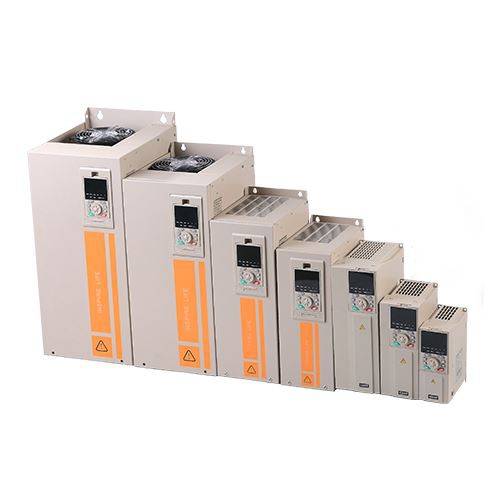
Hey there! As a supplier of AC Control Drives, I often get asked about how the phase - loss protection of these drives works. It's a crucial feature that ensures the smooth and safe operation of the drives, so I'm excited to break it down for you.
First off, let's understand what phase - loss is. In a three - phase AC power system, which is commonly used in industrial and commercial applications, there are three separate electrical waveforms that are 120 degrees out of phase with each other. Phase - loss occurs when one of these phases is lost or fails. This can happen due to various reasons, such as a blown fuse, a broken wire, or a malfunctioning contactor.
Now, why is phase - loss protection so important? Well, when a phase is lost in an AC Control Drive, it can cause a whole bunch of problems. The drive may overheat, the motor may experience uneven torque, and in severe cases, it can even lead to motor damage. Phase - loss protection is designed to detect this issue and take appropriate action to prevent these problems.
So, how does the phase - loss protection mechanism in an AC Control Drive actually work? There are a few different methods, and I'll go through the most common ones.
Voltage Sensing Method
One of the simplest and most widely used methods is voltage sensing. The AC Control Drive continuously monitors the voltage of each phase. If the voltage of one phase drops below a certain threshold, it indicates a phase - loss condition.
The drive has built - in voltage sensors that are connected to each phase. These sensors send the voltage readings to the drive's control board. The control board then compares the voltage of each phase. If the difference between the voltages of two phases exceeds a pre - set limit, the drive assumes that a phase - loss has occurred.
Once the phase - loss is detected, the drive can take different actions. In some cases, it may immediately shut down the motor to prevent damage. In other cases, it may reduce the speed of the motor or issue an alarm to alert the operator.

Current Sensing Method
Another method is current sensing. In a balanced three - phase system, the current in each phase is equal. When a phase - loss occurs, the current distribution becomes uneven. The AC Control Drive uses current sensors to measure the current in each phase.
If the current in one phase is significantly different from the other two, it's a sign of phase - loss. Similar to the voltage sensing method, the drive's control board analyzes the current readings. When a phase - loss is detected, the drive can take appropriate measures to protect the motor and itself.
Phase Angle Monitoring
Phase angle monitoring is a more advanced method. It involves measuring the phase angle between the different phases. In a healthy three - phase system, the phase angle between each pair of phases is exactly 120 degrees.
If a phase - loss occurs, the phase angle relationship is disrupted. The AC Control Drive uses phase angle sensors to measure these angles. The control board then checks if the phase angles are within the normal range. If not, it indicates a phase - loss condition.
This method is more accurate in detecting phase - loss, especially in systems where the voltage or current variations may not be very obvious. However, it requires more complex sensors and algorithms, so it's often used in high - end AC Control Drives.
Now, let's talk about some real - world applications of these phase - loss protection methods. In industrial settings, AC Control Drives are used to control the speed and torque of motors in various machines, such as conveyor belts, pumps, and fans. Phase - loss protection ensures that these machines operate safely and efficiently.
For example, if you're using a 5.5KW VFD to control a conveyor belt in a factory, the phase - loss protection feature will prevent the motor from getting damaged in case of a phase - loss. This not only saves you the cost of replacing the motor but also reduces downtime, which is crucial for maintaining production levels.
In commercial applications, AC Control Drives are used in HVAC systems. A 110v VFD Drive can be used to control the fans and pumps in an air - conditioning system. Phase - loss protection ensures that the system operates smoothly, providing a comfortable environment for the occupants.
And for outdoor applications, like in water treatment plants or solar power systems, Outdoor VFD are used. These drives are exposed to harsh environmental conditions, and phase - loss protection becomes even more important. It protects the drive and the connected equipment from damage due to phase - loss, which could be caused by lightning strikes or other external factors.
In conclusion, phase - loss protection is a vital feature of AC Control Drives. It helps to prevent motor damage, reduce downtime, and ensure the safe and efficient operation of various electrical systems. Whether you're in an industrial, commercial, or outdoor setting, having a reliable phase - loss protection mechanism in your AC Control Drive is a must.
If you're in the market for an AC Control Drive or want to learn more about our products, we'd love to hear from you. Contact us to discuss your specific requirements and let's work together to find the perfect solution for your needs.
References
- “Power Electronics: Converters, Applications, and Design” by Ned Mohan, Tore M. Undeland, and William P. Robbins
- “Electric Machinery Fundamentals” by Stephen J. Chapman