

As a supplier of VF Control VFDs, I've witnessed firsthand the crucial role torque control plays in the performance and efficiency of variable frequency drives. In this blog, we'll explore the various torque control methods of a VF Control VFD, delving into their principles, advantages, and applications.
Understanding Torque in VFDs
Torque is the rotational force that causes an object to rotate around an axis. In the context of VFDs, torque control is essential for maintaining the desired speed and performance of the motor under different load conditions. A VF Control VFD (Variable Frequency Drive) adjusts the frequency and voltage supplied to the motor to control its speed and torque.
Direct Torque Control (DTC)
One of the most advanced torque control methods is Direct Torque Control (DTC). DTC offers a direct and rapid control of the motor's torque and flux. Instead of using a complex coordinate transformation like in other methods, DTC directly selects the optimal voltage vector based on the difference between the reference and actual torque and flux values.
The principle behind DTC is to minimize the error between the desired and actual torque and flux. By using a hysteresis controller, DTC can quickly adjust the voltage vector to keep the torque and flux within the specified bands. This results in a very fast dynamic response, which is particularly useful in applications where rapid changes in torque are required, such as in robotics and high - speed machining.
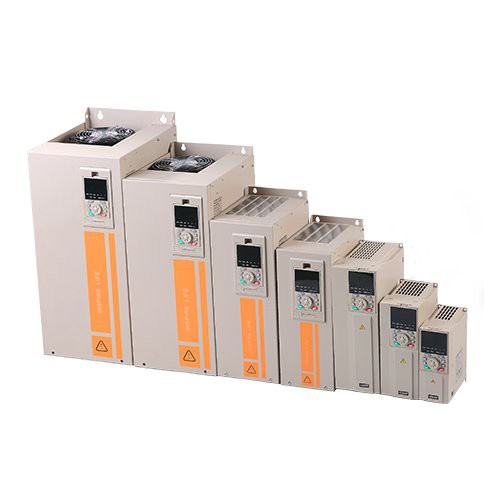

Advantages of DTC include:
- Fast dynamic response: It can achieve a torque response time in the order of milliseconds, allowing for quick acceleration and deceleration of the motor.
- High torque accuracy: Precise control of torque can be maintained even under varying load conditions.
- Simplified control structure: Since it doesn't rely on complex coordinate transformations, the control algorithm is relatively simple, reducing the computational burden on the controller.
However, DTC also has some limitations. It can generate relatively high levels of torque ripple, which may cause mechanical vibrations in the motor and the connected equipment. Additionally, the switching frequency of the inverter in DTC is not constant, which can lead to electromagnetic interference (EMI) issues.
Vector Control
Vector control, also known as field - oriented control (FOC), is another widely used torque control method for VF Control VFDs. The basic idea of vector control is to transform the three - phase stator currents of the motor into two orthogonal components: the torque - producing component (q - axis current) and the flux - producing component (d - axis current).
In vector control, the stator currents are first measured and then transformed from the stationary three - phase reference frame to a rotating two - phase reference frame that is aligned with the rotor flux. By independently controlling the q - axis and d - axis currents, the torque and flux of the motor can be controlled separately.
There are two main types of vector control: direct vector control and indirect vector control. In direct vector control, the rotor flux position is directly measured using sensors such as Hall sensors or encoders. Indirect vector control, on the other hand, estimates the rotor flux position based on the motor's electrical parameters and the measured stator currents.
Advantages of vector control include:
- High torque control accuracy: It can provide very precise control of torque, making it suitable for applications that require high - precision speed and torque regulation, such as in elevators and textile machinery.
- Low torque ripple: Compared to DTC, vector control generally produces less torque ripple, resulting in smoother operation of the motor.
- Constant switching frequency: The inverter in vector control operates at a constant switching frequency, which helps to reduce EMI.
However, vector control also has some drawbacks. It requires accurate knowledge of the motor's electrical parameters, such as stator resistance, rotor resistance, and mutual inductance. Any errors in these parameters can affect the performance of the control system. Additionally, the control algorithm is more complex than DTC, requiring a more powerful controller.
V/F Control with Torque Boost
V/F control is the simplest and most commonly used control method for VFDs. In V/F control, the ratio of the voltage (V) to the frequency (F) is kept constant to maintain a relatively constant magnetic flux in the motor. However, at low frequencies, the stator resistance voltage drop becomes significant, which can cause a decrease in the motor's torque.
To compensate for this, torque boost is added to the V/F control. Torque boost increases the voltage at low frequencies to maintain the motor's torque. This is achieved by adding an additional voltage component to the output voltage of the VFD based on the frequency.
Advantages of V/F control with torque boost include:
- Simple control algorithm: It is easy to implement and requires minimal knowledge of the motor's parameters.
- Low cost: Since it doesn't require complex sensors or control algorithms, the cost of the VFD is relatively low.
- Suitable for general - purpose applications: It is widely used in applications where precise torque control is not critical, such as in fans, pumps, and conveyors.
However, V/F control with torque boost has limited torque control capabilities. It cannot provide the same level of torque accuracy and dynamic response as DTC or vector control. The torque boost is a fixed compensation, which may not be optimal for all load conditions.
Applications of Different Torque Control Methods
- Direct Torque Control: DTC is well - suited for applications that require fast dynamic response and high - torque performance, such as in electric vehicles, high - speed trains, and industrial robots. For example, in an electric vehicle, DTC can quickly adjust the motor's torque to provide smooth acceleration and deceleration, improving the vehicle's driving experience.
- Vector Control: Vector control is commonly used in applications that demand high - precision speed and torque control, such as in machine tools, elevators, and textile machinery. In a machine tool, vector control can ensure accurate cutting forces by precisely controlling the motor's torque, resulting in high - quality machining.
- V/F Control with Torque Boost: V/F control with torque boost is widely used in general - purpose applications where cost - effectiveness is a major concern, such as in fans, pumps, and blowers. In a fan application, it can maintain a relatively constant speed and provide sufficient torque to drive the fan blades.
Conclusion
In conclusion, the choice of torque control method for a VF Control VFD depends on the specific requirements of the application. Direct Torque Control offers fast dynamic response but may have issues with torque ripple and EMI. Vector Control provides high - precision torque control but requires accurate motor parameters and a more complex control algorithm. V/F Control with Torque Boost is simple and cost - effective but has limited torque control capabilities.
As a supplier of VF Control VFDs, we can provide you with the most suitable VFD solution based on your application needs. Whether you need a VFD Variable Frequency Drive for a general - purpose application or a high - performance Single Phase VFD Drive for a specialized task, or a Normal Duty and Heavy Duty VFD to handle different load conditions, we have the expertise and products to meet your requirements.
If you are interested in our VF Control VFD products or need more information about torque control methods, please feel free to contact us for a detailed discussion and procurement negotiation. We look forward to working with you to achieve the best performance and efficiency for your applications.
References
- Boldea, I., & Nasar, S. A. (2005). Electric Drives: An Integrative Approach. CRC Press.
- Novotny, D. W., & Lipo, T. A. (2006). Vector Control and Dynamics of AC Drives. Oxford University Press.
- Bose, B. K. (2002). Modern Power Electronics and AC Drives. Prentice Hall.